AI Tokenomics: Cheaper Tokens, Bigger Bills
By: Kate Strachnyi
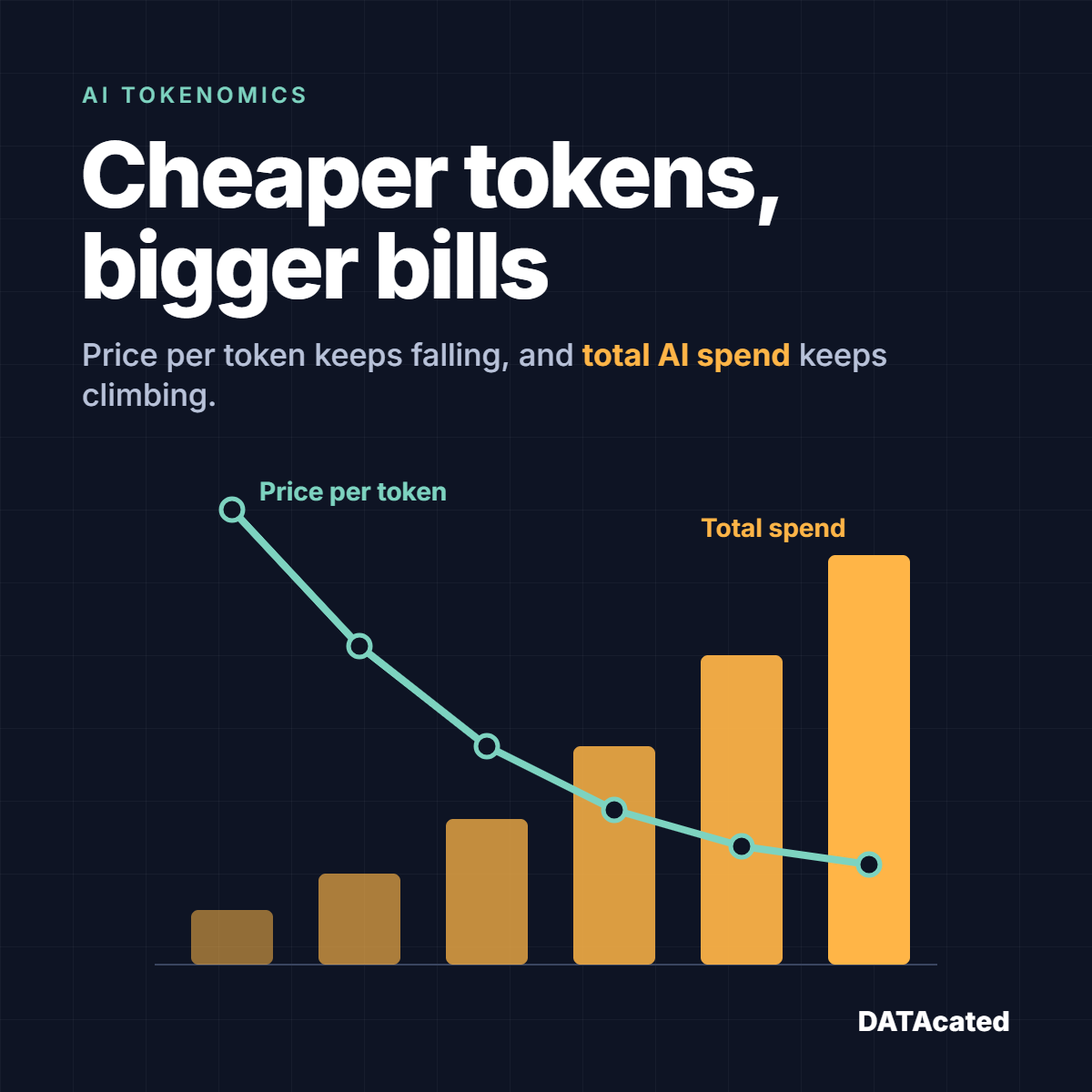
The word "tokens" comes up in almost every conversation I have with data and AI leaders right now, and it usually comes up when someone is staring at their AI bill. Here's my attempt to explain AI tokenomics in plain language: what you're actually paying for, why the price per token keeps dropping, and why so many companies are still spending MORE on AI than they planned.
So what is a token?
A token is a small chunk of text that a model reads or writes (roughly three quarters of a word in English), and every major model provider charges you per million of them. You pay for the tokens you send in and the tokens the model sends back, and output tokens usually cost several times more than input tokens because the model has to generate them one at a time.
Here's where your tokens actually go:
- Input tokens: your prompt, the system instructions, any documents or data you attach, and the full conversation history.
- Output tokens: the answer, plus the hidden "thinking" that reasoning models do before they respond, and yes, you PAY for that too.
- Context: everything the model has to re-read each time it takes a step, which adds up FAST once agents get involved.
The price per token has dropped like a rock. When OpenAI launched the GPT-3 API in June 2020 it charged $60 per million input tokens, and by early 2026 economy-tier models like Gemini 2.0 Flash were doing comparable or better work for about $0.10 per million, which is roughly a 600x drop in under six years (source).
Why is the bill going up if tokens are getting cheaper?
Cheaper tokens make people use a lot more of them, and the volume is growing faster than the price is falling. Economists call this the Jevons paradox (when steam engines got more efficient, England ended up burning MORE coal), and AI is following the same pattern.
Gartner forecasts LLM inference costs will drop about 90% by 2030, but it also warns that those savings won't be fully passed on to enterprise customers and that frontier models will need far more tokens than the apps most companies run today (source). Uber reportedly burned through its entire 2026 AI budget in four months, which tells you how quickly this can get away from a company (source).
A few things are driving the volume:
- Agents: they plan, call tools, call other agents and re-read their context at every step, so a single task can burn through dozens of times more tokens than a chatbot answer.
- Reasoning models: they think step by step before answering, and those hidden thinking tokens show up on your invoice.
- Bigger context: longer system prompts, more retrieved documents and longer chat histories all get re-sent with every call.
- Usage-based pricing: more AI vendors bill by consumption instead of by seat, so the bill follows usage rather than headcount and gets much harder to forecast.
How to keep token spend under control
The teams I see doing this well treat tokens like any other line item, and they measure what each workflow costs against what it delivers. Here is what they do:
- Route by task: send classification, extraction and simple summaries to small, cheap models, and save the expensive reasoning models for work that actually needs them.
- Cache what repeats: system prompts, policy docs and product catalogs get sent over and over, and most providers give you a big discount on cached input tokens.
- Trim the context: if the model needs one section of a document, send that section instead of the whole thing.
- Put limits on agents: set budgets and step limits per workflow, and get an alert when spend spikes.
- Measure cost per outcome: track cost per resolved ticket, per qualified lead or per finished report, because total tokens by themselves don't tell you much.
And here's the part I love for the data crowd: clean, well-organized data saves you tokens. When your data is a mess, teams stuff more context into every prompt to make up for it, and you pay for that mess on every single call.
The bottom line
Token prices will keep falling, and AI bills will probably keep climbing for most companies because agents and reasoning models are hungry. The companies that win here know what each workflow costs, pick the right model for the job and keep their data clean enough that they aren't paying to re-explain it on every call.
If you're building a product that helps teams get AI spend under control (observability, FinOps, model routing, caching), buyers want to hear that story right now, and we'd love to help you tell it at DATAcated.
Sources
Subscribe for industry
updates & insights
Captivating interviews with industry experts
Gain insights into the latest data trends, discover the advancements in AI and machine learning, explore innovative data software, and gain knowledge from influential individuals shaping the data landscape.
Fresh content
Continuously generating content with interviews that cover the latest topics.
Exclusive interviews
Interviews with experts in data analytics and AI to make sure you stay ahead of trends.

Explore our latest insights

Explore our various solutions

Amplify your brand
We are here to support your content creation and amplification needs. Click on "Learn more" to get additional information on how we can help!
Personal Brand Builder
We aim to enhance brand recognition through insightful content in data analytics and AI.
Intentional use of color