
Cloud vs On-Prem for Agentic AI: How to Pick
By: Steve Allayev
Most of the advice out there about cloud vs on-prem was written back when AI just answered questions, and it stops working once your AI starts DOING things. Here's my attempt to explain the tradeoffs in plain terms.
Quick note on what makes an agent different. A chatbot answers you once and stops, but an agent works in a loop, so it thinks, calls a tool, looks at what came back, and then tries the next step. That loop is what changes the whole decision.
Why agents change things
The bill grows fast. One agent task is not one call to the model, and a task that runs ten steps can use 30 to 50 times more tokens than a single chat answer. That shows up on your bill in about a week, which is why teams who priced their pilot like a chatbot got a nasty shock in month two.
Small errors pile up. Say each step works 95% of the time, which sounds great until you chain ten of them together, because then the full task only works about 60% of the time. Errors multiply, so the model you pick matters much more for agents than it ever did for chat.
Agents can break real things. A search tool that gets it wrong just hands someone a bad answer, but an agent that gets it wrong can change 400 records in your CRM or send email to your whole customer list, so where the agent runs and what it can reach turns into a serious question.
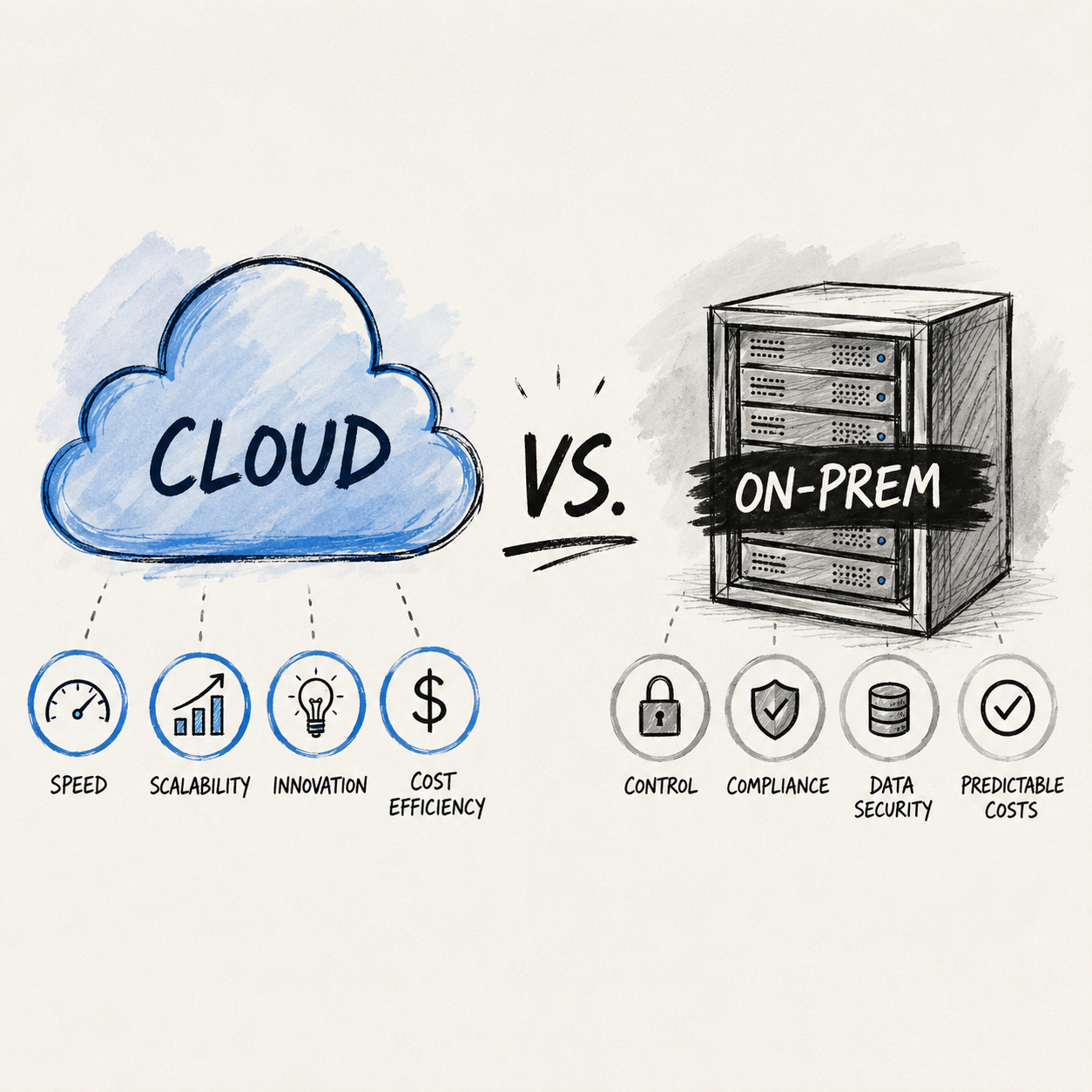
When cloud is the better pick
You want the newest model: better models come out every few months, and in the cloud you switch by changing one line of code, but on your own hardware that same switch means buying, testing, and rebuilding.
Your traffic jumps around: one person starting a big task can kick off hundreds of calls, and you don't want to buy enough machines to cover your busiest hour of the month.
Nobody has to babysit servers: plan on half a person to a whole person just to keep a GPU cluster alive, dealing with drivers, broken machines, and updates, and most data teams don't have that person sitting around.
You can start this week: earlier this year it took 2 to 6 weeks to get H100 servers and 4 to 8 weeks for H200s, so if you want something live this quarter, cloud is really your only option.
Prices keep dropping: API prices fell a lot through 2025 and 2026, which means the money case you built for buying hardware last year probably looks worse today.
When on-prem is the better pick
Your data is not allowed to leave: this is the cleanest reason of all, and it's not a preference, it's an answer you get from legal instead of guessing at. If you work in defense or healthcare, or you have rules about which country your data sits in, the choice is already made for you.
The agent needs to sit close to your data: agents don't just read files, they call your systems and write to them, so every step means another trip out and back, and ten trips cost you real time and real money.
You use a LOT of it: the rough break-even in 2026 lands somewhere around 2 to 5 million tokens a day, and you also need to keep those GPUs busy most of the time (most estimates say 70 to 85%), because below that you're mostly paying for machines that sit idle at 3am.
The network becomes a wall: if the agent simply cannot reach the internet, a whole group of security worries goes away, and that's a much easier story to tell your risk team.
Free models got good: models you can download and run yourself, like GLM-5.2, Kimi K2.6 and K3, DeepSeek V4, and the Qwen 3.6 family, now handle agent work well. Check the license yourself before you build on one, because that part changes fast.
What most companies really do
Almost nobody picks one side and stops there, and the pattern I keep seeing is a split by the type of work instead of by the company.
The simple, boring steps run on a small model in your own building, things like sorting, pulling details out of text, and cleaning up what a tool sent back, and those steps are usually most of the calls in the loop. The hard steps go out to a big cloud model, meaning planning and anything where a bad call spreads to everything after it. Your data stays home, and only the small piece of context needed for that one hard call goes out.
It's more work to build than either extreme, but you get the low running cost of your own hardware plus the smarts of the cloud, and a better model next quarter becomes an upgrade instead of wasted money.
Five questions to ask first
- How many of your agent's steps really need the biggest model, and did you measure that or just guess?
- How many tokens do you use on a normal day, not your busiest day?
- Is your data allowed to leave, and does legal agree with you?
- Who fixes the server at 2am, and have you asked them yet?
- How fast do you want to switch when a better model shows up in six months?
Both choices lock you in somehow. Cloud means living with someone else's prices and rules, and your own hardware means living with the machines and the model you bought before you knew what you'd actually need. Pick the one you can live with, then check again in a year, because this math keeps moving.
Subscribe for industry
updates & insights
Captivating interviews with industry experts
Gain insights into the latest data trends, discover the advancements in AI and machine learning, explore innovative data software, and gain knowledge from influential individuals shaping the data landscape.
Fresh content
Continuously generating content with interviews that cover the latest topics.
Exclusive interviews
Interviews with experts in data analytics and AI to make sure you stay ahead of trends.



.png)
Explore our various solutions

Amplify your brand
We are here to support your content creation and amplification needs. Click on "Learn more" to get additional information on how we can help!
Personal Brand Builder
We aim to enhance brand recognition through insightful content in data analytics and AI.
Intentional use of color
